
Anúncios
Today’s in-dash hub mixes maps, music, phone links, and voice help into one easy center. For US shoppers, think of the infotainment setup as the touchscreen and controls that blend information and entertainment. It also often adjusts comfort and vehicle settings.
“Smarter than ever” means faster updates, cleaner voice commands, stronger connectivity, and more ways to personalize your ride. The infotainment system is now the front door to how you navigate, call, stream, and tweak the cabin.
Buying a car today means choosing between phone mirroring or built-in platforms, touch-only screens or physical controls, and services that charge extra or update over the air.
Later sections will cover day-to-day features that matter, what’s worth paying for, and non-negotiables like safety, privacy, and reliability for modern connected cars.
Why automotive infotainment systems matter more to US car buyers today
The cockpit’s software matters to many shoppers in ways a radio never did. Buyers now evaluate a vehicle by its digital feel as much as by specs. That shift has real impact on purchase choices.
Anúncios
From simple radios to connected digital cockpits
What used to be a radio plus CD player is now a unified interface with multiple screens and shared software. This change created full digital cockpits that tie navigation, media, and vehicle controls together.
Why in-car tech influences purchase decisions
About 60% of consumers say these features play a critical role in buying or leasing. A smooth interface can outweigh brand loyalty for many shoppers.
Market momentum and what it signals for shoppers
The market was valued near $15 million in 2023 and could hit $29 million by 2030. Faster innovation means more OTA updates, more partnerships, and varied trim choices.
Anúncios
- More updates and subscriptions change ownership over time.
- Google-based platforms and streaming tie cars into daily life.
- Infotainment shapes the driving experience for commutes, navigation, calls, and EV stops.
| Trend | Buyer Impact | Short-term Expectation | Long-term Signal |
|---|---|---|---|
| Multi-screen cockpits | Smoother menus, richer displays | More models adopt this | Higher software value in trims |
| OTA updates | Keeps features current | Frequent patches | Shift to software-defined vehicle |
| Platform partnerships | Familiar apps, voice | Expanded app support | Subscription ecosystems |
Next: we’ll dig into what “smart” means under the hood — HMI, OS, connectivity, cloud, and AI.
Core building blocks behind a “smart” infotainment system
A smart stack links a clear interface, reliable core software, live networks, cloud services, and adaptive AI.
Human-machine interface that reduces distraction
The HMI blends touch, voice, and simple physical controls. Good design favors large icons, short task flows, and shallow menus so drivers complete tasks quickly and safely.
Operating systems and middleware
Choices like Android Automotive OS and QNX shape stability, app support, and update speed. A strong OS lets the rest of the system run without hiccups.
Connectivity modules for real-time information
Bluetooth handles calls and audio. Wi‑Fi boosts data-heavy tasks. Cellular links deliver maps, traffic, and streaming beyond a paired phone. Together they keep the car current.
Cloud, edge computing, and OTA updates
Cloud hosts services and content. Edge computing keeps responses fast near the car. Over-the-air updates can add features or fix bugs after purchase.
AI and machine learning
AI learns routines and media preferences, sharpens voice recognition, and helps assistants surface helpful suggestions. The trade-off is added complexity; the best solutions feel simple and reliable to the user.
Phone-first vs built-in: choosing between Apple CarPlay, Android Auto, and embedded systems
Deciding between phone mirroring and an embedded platform changes how you use maps, music, and hands-free features every day.
Apple CarPlay and Android Auto basics for everyday driving
Apple CarPlay and Android Auto bring a familiar phone UI to the car. They make calls, texts, music, podcasts, and navigation easy to access. Most drivers like the quick learning curve and reliable app ecosystem.
Wireless vs wired pairing via Bluetooth, Wi‑Fi, and USB
USB pairing is more stable and charges your phone. Wireless adds convenience but can show latency or dropouts on some routes.
Test both: pairing speed, reconnection after a stop, and audio handoff during calls.
When built-in navigation and apps beat phone mirroring
Built-in navigation can use vehicle sensors, EV routing, and head-up displays. It often works without a phone and can offer deeper integration with vehicle controls and range planning.
Cross-device syncing with calendars, media, and accounts
Expect calendars, contacts, and media accounts to sync across devices and cloud services. Some models extend access into wearables or cloud profiles for a seamless commute.
“Some brands blend a Google-built embedded experience with CarPlay support, so you can choose per trip.”
- Buyer checklist for a test drive: pairing speed, mic quality, call clarity, and media playback.
- Confirm which version of CarPlay/Android Auto and what capability comes with the trim and model year.
Interface and usability: what to look for in an infotainment screen and controls
Good in-cabin design lets drivers complete common tasks with almost no glance time.
Touchscreen layout and menu simplicity
The best infotainment screen uses large icons, clear contrast, and shallow menus. Check whether common tasks take one or two taps. Look for quick responsiveness and low glare on sunny days.
Physical buttons and hybrid controls
Hard buttons for volume, defrost, and temperature speed up interaction. Rotary controllers or a hybrid console work well on long drives by letting the driver keep eyes forward.
Evaluating voice recognition
Try voice commands for calls, texts, media, and climate. See if the voice learns your tone and works well at highway speeds.
Test-drive script
- Pair your phone; test reconnection after a short stop.
- Ask for a route and check navigation prompts.
- Change audio source and adjust temperature using both touch and buttons.
- Use voice to place a call and send a quick text.
| Control Type | Strength | Best for | Consideration |
|---|---|---|---|
| Touch-only screen | Direct, modern | Intuitive menus | Can require more glances |
| Rotary/hybrid | Eyes-forward use | Long drives, precise control | Steeper learning curve |
| Physical buttons | Fast, reliable | Safety-critical tasks | Less flexible for new features |
Ownership note: A fast, predictable display and clear controls matter more than flashy features. Interfaces that slow you down lower long-term satisfaction, even on high-end trims.
Display and hardware upgrades that change the in-cabin experience
Sharper displays and faster chips turn a dashboard into an active, glanceable workspace.
SoC makers now deliver high-performance, low-power processors that run multiple screens without lag. This keeps maps and animations smooth and lets the vehicle show split-screen layouts reliably.
Multi-screen cockpit trends
Today’s cabins often combine a center display, instrument cluster, HUD, and rear-seat screens. Each screen serves a role: driver info, passenger controls, or rear entertainment.
What high-resolution changes in practice
Higher pixel density means clearer navigation, sharper backup-camera feeds, and easier-to-read text in sunlight.
Head-up and rear-seat value
Head-up panels keep navigation prompts and alerts in sight, reducing glances down. Seat-back displays offer independent entertainment and streaming for families on long trips.
| Display Type | Main Benefit | Buyer Check |
|---|---|---|
| Center display | Primary control, maps | Responsiveness, glare |
| Instrument cluster | Speed, range, alerts | Readability, update speed |
| HUD | Eyes-forward navigation | Positioning, brightness |
| Rear-seat screens | Streaming, games | Resolution, network support |
EV note: Extra screens draw power; efficient chips help protect range. When shopping, test for heat, dimming, and responsiveness with multiple apps running.
Smart features that make modern systems feel “intelligent”
Smart features now predict what drivers need before they ask, saving taps and attention.
AI-driven personalization uses calendar items, past trips, and in-cabin sensors to suggest routes, precondition climate, and surface often-used apps. About 89% of drivers say they welcome AI that helps the driving experience without distraction.
Contextual navigation and real-time routing
Live traffic, incident alerts, and adaptive ETAs reroute proactively in congested US metros. This improves arrival accuracy and reduces last-minute lane changes.
Wellness and edutainment
Features like guided breathing, posture prompts, and branded modes such as Mercedes‑Benz Energizing Comfort offer comfort on long drives. Passengers get richer media through multi-screen layouts.
AR, 3D, and multi-screen reality
Lane-level overlays and 3D maps make complex interchanges clearer. Split screens let navigation and media coexist for a smoother in-cabin experience.
Ambient feedback
Lighting themes, subtle haptics, and soundscapes (MINI’s sync examples) reinforce alerts and create a cohesive cabin feel.
“Intelligent means helpful, not gimmicky—anticipate needs, cut steps, and stay safe.”
| Smart Area | Benefit | Buyer Check |
|---|---|---|
| AI personalization | Fewer taps, tailored comfort | Does it learn reliably? |
| Contextual navigation | Faster reroutes, better ETAs | Test on congested routes |
| Wellness & AR | Less fatigue, clearer directions | Try wellness modes and overlays |
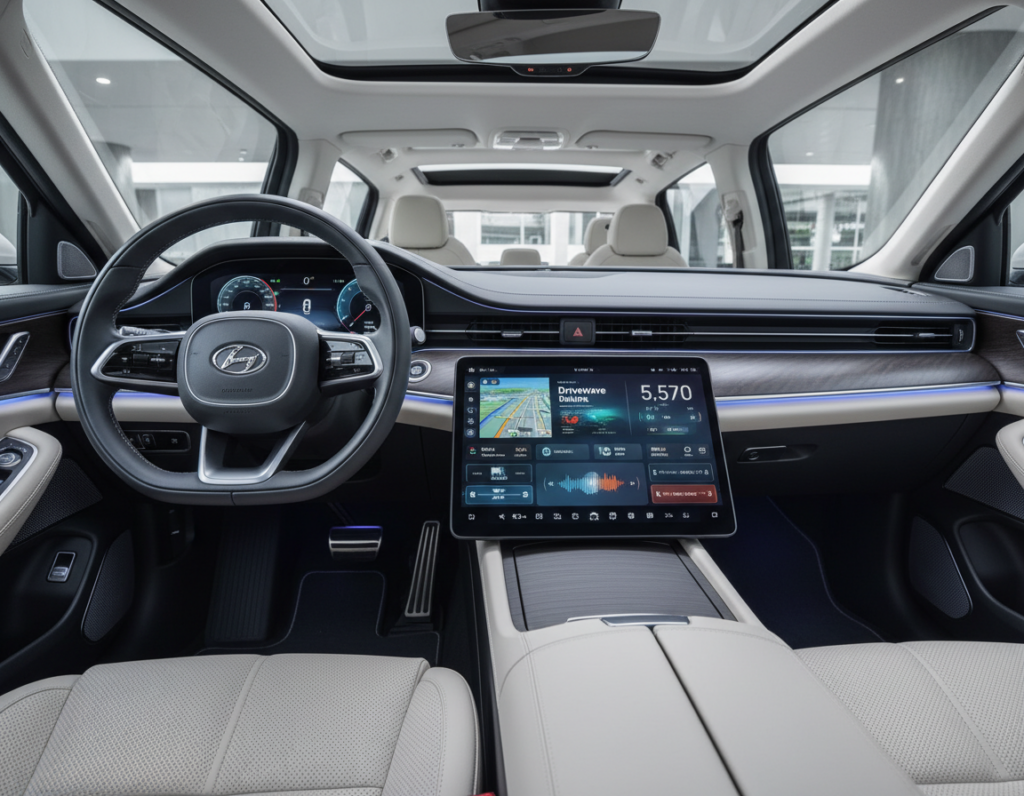
Safety, privacy, and reliability: the non-negotiables in connected infotainment
A reliable in-car interface must protect attention, data, and uptime to deliver lasting value. Drivers need tech that helps, not distracts. Safety and privacy are as important as maps and media.
Designing for attention management and safer interactions
Attention management means fewer steps, clear feedback, and interaction patterns that discourage long glances away from the road.
- Make common tasks one-or two-tap actions.
- Use large tap targets and predictable home-button behavior.
- Provide immediate visual or haptic feedback so the driver need not stare.
Cybersecurity and data privacy protections that build trust
Ask the hard questions: what information is collected, how it is used, how long it is stored, and can you delete profiles?
Baseline protections include end-to-end encryption, multi-factor authentication, secure OTA updates, and clear privacy-by-design policies.
Why rigorous testing matters for performance and brand confidence
Complex stacks demand broad testing across HMI/UX, software stability, and connectivity (4G/5G, Wi‑Fi, Bluetooth), plus voice and AI accuracy.
Flaws can harm driver safety and brand trust. Testing platforms are projected to grow as the market addresses these risks.
Quick buyer checks: confirm large buttons, test navigation/audio/camera responsiveness, and note any lag that invites repeated taps.
“A well-tested system is an ownership asset — it stays usable and secure over the vehicle’s life.”
Cost, upgrades, and long-term value: what you’re really buying
Total ownership now includes more than the sticker price. Expect ongoing software support, update cadence, and possible subscription fees to shape the long-term cost of a car.
Over-the-air updates and the software-defined shift
OTA updates deliver bug fixes, UI refinements, new apps, and occasional feature unlocks. About 90% of new vehicles will support OTA by year-end, so update policy matters as much as hardware.
Subscriptions, in-car purchases, and streaming partnerships
Expect premium navigation, connected services, and streaming bundles that can be paywalled. Confirm trial length, renewal pricing, and which features remain if you stop paying.
Energy efficiency and EV range considerations
Always-on connectivity and bright multi-screen layouts use power. Low-power chips and lean software help protect EV range, so ask about efficiency for your chosen model.
Quick buyer checklist:
- How long are updates guaranteed?
- What transfers on resale?
- Which features work offline or without a subscription?
The best infotainment experience is one that stays fast, supported, and adds real value across the vehicle’s life. For aftermarket upgrade options, see best aftermarket car infotainment systems.
Conclusion
A truly smart in-car hub responds fast, keeps solid connections, uses helpful AI, and follows a clean design that reduces distraction.
When choosing, pick your platform approach (CarPlay/Android Auto or an embedded option). Then prioritize usability: screen clarity, physical controls, and voice accuracy. Finally, weigh features, update policies, and subscription costs.
The best systems feel simple while you are driving: quick access to navigation and media, reliable pairing, and minimal menu digging. Safety, privacy, and reliability are must-haves, not extras.
With rapid market change, test tech on a drive. Bring your phone, run your common tasks, and choose the model and interface that match how you drive today.



 English