
Anúncios
Lightweighting means cutting mass where it matters so cars and trucks use less fuel, handle better, and free up space for batteries or cargo. This approach links lower weight to improved efficiency and sharper on-road performance in real-world vehicles.
This piece is a practical buyer’s guide for OEM teams, Tier suppliers, fleet managers, enthusiasts, and repair or retrofit buyers. It focuses on choices you can make today to balance cost, manufacturability, and serviceability.
We preview major families—metals and steels, polymers, and composites—and explain why the best option depends on application, cost, and production limits rather than chasing the absolute lightest part.
The core lens used here weighs safety, repair realities, and long-term durability against mass savings. Expect faster change now, driven by innovation in materials science and tighter efficiency targets across the United States.
Throughout the guide we emphasize practical outcomes—fuel use, handling feel, braking, payload, and corrosion—plus recurring terms like component-level mass savings and system-level trade-offs to keep decisions grounded in real engineering.
Anúncios
Why Lightweighting Matters in Modern Vehicle Engineering
Automakers often turn to mass savings first because it delivers immediate efficiency gains across powertrains. In the U.S., CAFE targets and tighter emissions rules push teams to reduce vehicle weight as a direct lever for better mpg and lower CO2.
Fuel efficiency and emissions pressure in the United States
Market Research Future notes CAFE targets aimed at roughly 54.5 mpg by 2025. That regulatory pressure makes weight reduction one of the fastest ways to raise efficiency without waiting for new propulsion tech.
How reducing vehicle weight improves performance without compromising safety
Every 10% drop in mass can yield about a 10% fuel saving, a measurable outcome for ICE and EV cycles.
Anúncios
Lower mass means less energy to accelerate and potential for shorter stopping distances when systems are tuned to match the change.
“Weight savings must be paired with the same or better safety and corrosion resistance to be valid engineering choices.”
What “strength-to-weight ratio” means for real-world design choices
Strength-to-weight ratio describes how much load a part carries per unit mass. A higher ratio favors materials that let designers use thinner, stronger sections without losing integrity.
- Where to use high-strength parts: crash rails, pillars, subframes—areas that must meet strict integrity targets.
- Where to choose convenience savings: closures, trim, aero pieces, and seat frames—places that boost handling feel or lower center of mass.
| Example | Typical Application | Benefit |
|---|---|---|
| Thinner high-strength sections | Safety cage members | Mass cut with maintained crash performance |
| Aluminum closures | Hood, trunk | Lower top mass; improved handling feel |
| Composite aero parts | Splitters, spoilers | Targeted weight reduction and improved efficiency |
Small, well-placed savings—like lighter seat frames or high-mounted trim—often change handling more than equal pounds removed low in the chassis.
Next: U.S. adoption varies by segment and cost, so the market snapshot shows where these choices are already having the most impact.
US Market Snapshot and Trends Shaping Lightweight Materials Automotive Adoption
US demand for lighter vehicle components is rising, and market forecasts show the supply base expanding through 2035.
The Market Research Future report values the U.S. sector at $12.11B in 2024 and projects $23.21B by 2035. Growth runs near a 6.09% CAGR from 2025–2035.
Market growth outlook through 2035
This expansion means more choices for buyers, greater supplier capacity, and quicker refresh cycles for vehicle programs. Expect more frequent part updates and broader application options.
Why aluminum holds the largest share
Aluminum leads because it fits existing supply chains and scales across closures, hoods, and some structures. Its crash energy behavior is well understood by manufacturers and regulators.
Advanced composites and fast growth
Advanced composites, including carbon fiber systems, post the fastest growth. They offer high stiffness and strength per pound and suit premium trims and targeted modules.
Sustainability, partnerships, and buyer takeaways
Sustainability drives demand for recycled content, lower-carbon metals, and bio-based composite options that still meet durability needs.
| Trend | Impact | Buyer Action |
|---|---|---|
| Segment growth | More suppliers | Prioritize US availability |
| Aluminum leadership | Broad applications | Validate joining and repair |
| Composites rise | Higher performance parts | Plan for repair/inspection |
| Partnerships | Faster innovation | Engage suppliers early |
Bottom line: competitive pressure and co-development, as seen with Novelis and Alcoa moves, are accelerating innovation. For buyers, focus on supply stability, validated repair methods, and a clear upgrade path as sustainability rules tighten.
Lightweight Automotive Materials Buyer’s Guide: How to Choose the Right Material
Begin your selection by mapping each part’s role: cabin comfort, exterior exposure, crash duty, or engine heat. That initial map sets the shortlist of viable material families and joining methods.
Match material to application. For interior trim, plastics and composites often win on cost and form. For exterior body panels, aluminum offers corrosion resistance and good energy absorption. Structural rails need high-strength steel or hybrid stacks to protect crash performance without compromising safety.
Cost versus weight reduction is a buyer-level calculation. Compare piece price, tooling, cycle time, scrap rate, repair costs, and insurance impact. Include total cost of ownership over the vehicle life, not just upfront spend.
Durability screening should mimic US conditions: road salt, coastal humidity, freeze-thaw cycles, heat, and vibration. Use accelerated corrosion and fatigue tests to vet long-term performance.
Design for crashworthiness by optimizing geometry, load paths, and hybrid structures. Thin, stronger sections plus energy-absorbing zones keep structural integrity while reducing weight.
Manufacturability and repairability matter. Stamping, casting, forging, injection molding, and RTM each carry different lead times and scale risks. Ask suppliers about repair methods—weldable, bondable, or replaceable parts affect fleets and insurers.
- Quick decision checklist: target weight reduction, allowable cost delta, required durability window, safety targets, and manufacturing scale.
- Finalize a shortlist of candidate materials, joining methods, and test plans.
“Good material choice equals the right balance of cost, durability, and safety for the system it joins.”
For a deeper procurement framework and examples, see this buyers guide: buyers guide. Next we review top material families and where each performs best.
Top Material Options and What They’re Best For
Match part function to material properties to get the best balance of mass, cost, and serviceability.
Carbon fiber and CFRP
Carbon fiber and CFRP deliver exceptional strength at ultra-low weight. They shine on closures, aero pieces, and select structural modules where performance matters most.
These options are ideal for cars that prioritize stiffness, heat resistance, and visual appeal. They are less suited to high-volume, high-repair-frequency areas because repair costs and cycle times can be high.
Aluminum and aluminum alloys
Aluminum is the volume-friendly metal: about 40% lighter than steel, corrosion resistant, and good at absorbing crash energy.
Use it for body panels, chassis parts, and certain engine components where manufacturability and cost scale matter.
Magnesium and titanium
Magnesium alloys are ~30% lighter than aluminum and work well for wheels, gearbox housings, and steering pieces where rotating feel matters.
Titanium is an exotic choice for exhausts, valves, and high-heat zones. It matches steel strength at much lower weight and resists heat and corrosion.
Advanced high-strength steel and reinforced plastics
Advanced high-strength steel enables thinner gauges for safety-critical structures, keeping costs down while preserving crash performance.
Plastics and reinforced composites offer design freedom for interior and non-structural exterior parts. They cut mass and allow integrated functions when specified correctly.
Best practice: combine families—steel safety cages, aluminum closures, and composite exterior pieces—to meet performance and budget goals.
Where Lightweight Materials Show Up in Vehicles Today
Walk a modern vehicle from bumper to trunk and you’ll see where mass-saving choices already shape performance and service plans.
Body panels and exterior systems
Hoods, trunks, and fenders are frequent targets because large surface area yields meaningful weight reduction. Swapping steel panels for aluminum or carbon fiber saves pounds and often improves handling feel.
Aero parts like splitters, spoilers, and diffusers usually use composites for low mass and high stiffness. That shape freedom also boosts highway performance when designs are validated.
Interior components
Trim, dashboards, and seats increasingly use polymer matrix composites and lightweight foams to cut mass while improving NVH and integration.
These components can reduce fasteners and simplify assembly, but durability and repair access must be validated for fleet use.
Structural and safety-critical areas
Chassis, safety cages, and crash reinforcements rely on high-strength steel and selective aluminum stacks to manage impact energy.
Safety zones keep conservative choices—thinner, stronger sections rather than exotic swaps—so occupant protection remains predictable.
Powertrain and thermal zones
Engine blocks and cylinder heads commonly use aluminum for heat cycling and vibration tolerance.
Titanium appears in exhaust and valvetrain parts in premium vehicles where heat resistance and reduced reciprocating mass matter. Composites are limited in hot zones unless their thermal rating allows long-term durability.
“The same material can succeed in one area and fail in another if heat, impact, and repair constraints are ignored.”
| Vehicle area | Common material | Why it’s used |
|---|---|---|
| Body panels | Aluminum, carbon fiber | Large area = meaningful weight cut; improved handling |
| Interior | Polymer composites, foams | Integration, NVH gain, fewer fasteners |
| Chassis / safety | High-strength steel, aluminum | Crash energy control and predictable durability |
| Powertrain / thermal | Aluminum, titanium | Heat cycling, vibration, and oxidation resistance |
Trade-Offs to Know Before You Buy or Specify Lightweight Parts
Selecting a part means matching performance targets to real-world service and supplier capabilities.
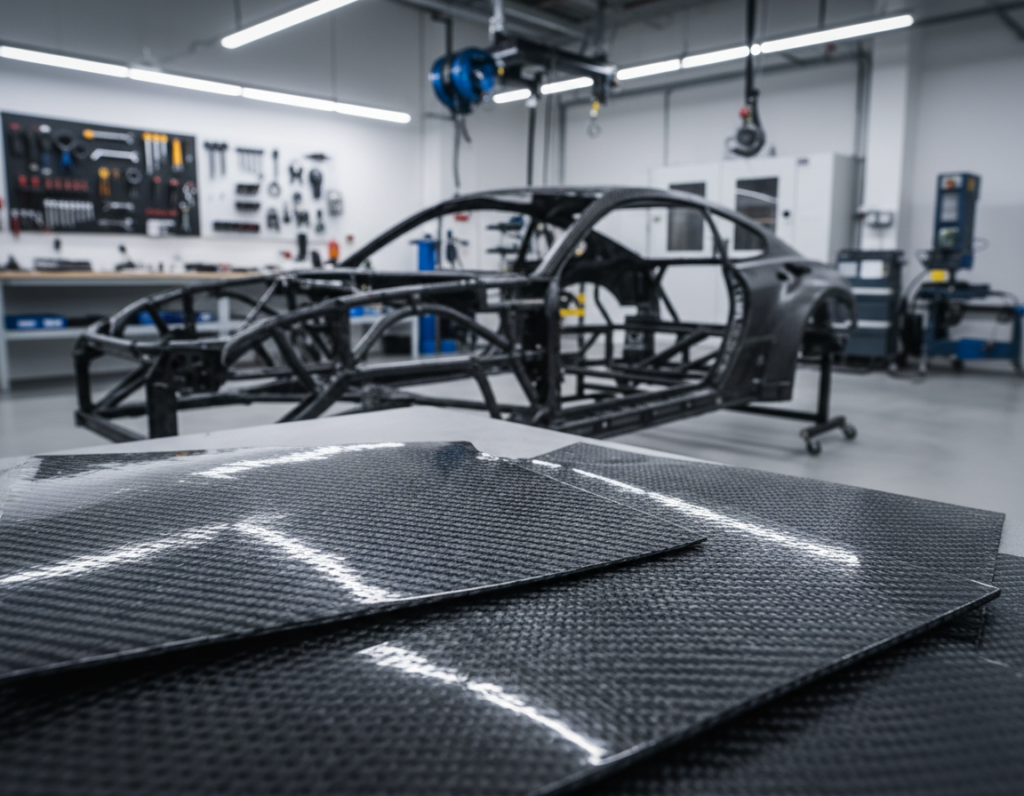
Carbon fiber vs. metals: repair complexity and durability
Carbon fiber offers exceptional strength and an outstanding strength-to-weight ratio, but it often comes with premium cost and longer cycle times.
For daily-driver cars, delamination risk, inspection needs, and patch-versus-replace decisions raise repair costs and downtime.
Tip: specify expected repair methods and acceptable cosmetic limits up front so suppliers and insurers know the plan.
Magnesium: the lightest metal with manufacturing caveats
Magnesium can drive significant weight reduction in rotating or highly sensitive parts.
However, forming, casting, finishing, and price volatility make it harder to scale than aluminum or steel.
Ask manufacturers about yield, finishing process, and availability before committing to magnesium for production runs.
High‑strength steel vs. aluminum: balancing ratio, cost, and safety
High‑strength steel often wins on affordability and proven crash performance using thinner gauges.
Aluminum gives good corrosion resistance and crash energy absorption and leads market share where scale matters.
Compare the weight ratio of candidate geometries rather than raw density: thin steel sections can match aluminum in many safety zones.
“Without compromising safety, joint engineering is the most common failure point—interfaces, not base metal, drive many field issues.”
To protect structural integrity, require joint specs (weld, rivet, or adhesive), validation testing, and an agreed repair strategy from suppliers and manufacturers.
- Define performance targets, cosmetic tolerances, and repair expectations in the purchase order.
- Require fatigue, corrosion, and UV tests for exterior carbon or composite parts.
- Validate forming and finishing plans for magnesium and aluminum to avoid production surprises.
Market note: aluminum’s broad share reflects scale and supplier ecosystems, while composites grow quickly where performance payoff outweighs cost.
Practical decision reminder: the best part meets safety and durability goals, fits your manufacturing plan, and delivers credible reducing weight at an acceptable total cost.
Conclusion
,Smart specification begins with application-focused goals, then proves performance with tests and supplier data.
In short, lightweight automotive materials are changing vehicles by raising efficiency and on-road performance while keeping safety and structural integrity intact.
Buyers should map each application, validate heat and impact exposure, confirm repairability, and pick the material that offers the best weight reduction per dollar.
In the U.S., aluminum keeps the largest share for scale, while composites grow where packaging and performance justify trade-offs.
Use a multi‑material approach across interior, body, and structure, and require manufacturers’ validation data for joining and production readiness.
Next step: build a shortlist, request corrosion, fatigue, and crash tests, and align suppliers and repair networks early to protect lifecycle cost.


 English