This introduction explains why a reliable cooling system matters for high-output builds. The system’s job is simple: help the engine warm up fast and then keep temperature steady under load.
On the track, while towing, or during spirited street driving, proper temperature control keeps power repeatable and parts alive. When heat gets out of hand, failures like blown head gaskets or cracked blocks can happen fast.
This guide breaks down how coolant flows through the block and radiator, how the thermostat and pressure cap work, and what to watch for when things go wrong.
You’ll learn practical checks and sensible upgrades that raise reliability without overcooling. For a deeper look at advanced designs that improve airflow and pump control, see this detailed post on advanced hot-weather performance.
Why High-Performance Engines Need Precise Temperature Control
High-output builds generate far more waste heat, so precise temperature control is no longer optional.
Higher cylinder pressures and sustained rpm produce continuous thermal load. That extra heat raises the risk of localized hot spots and detonation.
When localized hotspots form, metal warps and sealing surfaces fail. The result can be blown head gaskets or, in extreme cases, cracked blocks from uneven expansion.
Running too cool is also harmful. An engine cold for long periods wears faster, burns fuel less efficiently, and makes more pollutants.
Precise temperature control means reaching operating temperature quickly and holding it steady across changing loads and outside air. Stability keeps oil viscosity and clearances in safe ranges.
- Track sessions: sustained high rpm and load.
- Stop-and-go: heat soak in traffic.
- Highway pulls: prolonged high-power demand.
| Risk | Cause | Consequence |
|---|---|---|
| Local hot spot | High cylinder pressure | Detonation, warped head |
| Overheat | Insufficient cooling flow | Head gasket failure |
| Too cold | Poor warm-up | Increased wear, emissions |
Think of the car cooling system as a regulator—it must dump heat when needed but also let the engine reach and keep the right temperature for peak life and performance.
Automotive Engine Cooling Systems: Core Components and What Each One Does
A properly matched set of core parts keeps heat where it belongs and prevents costly failures under heavy load.
Radiator: the heat exchanger
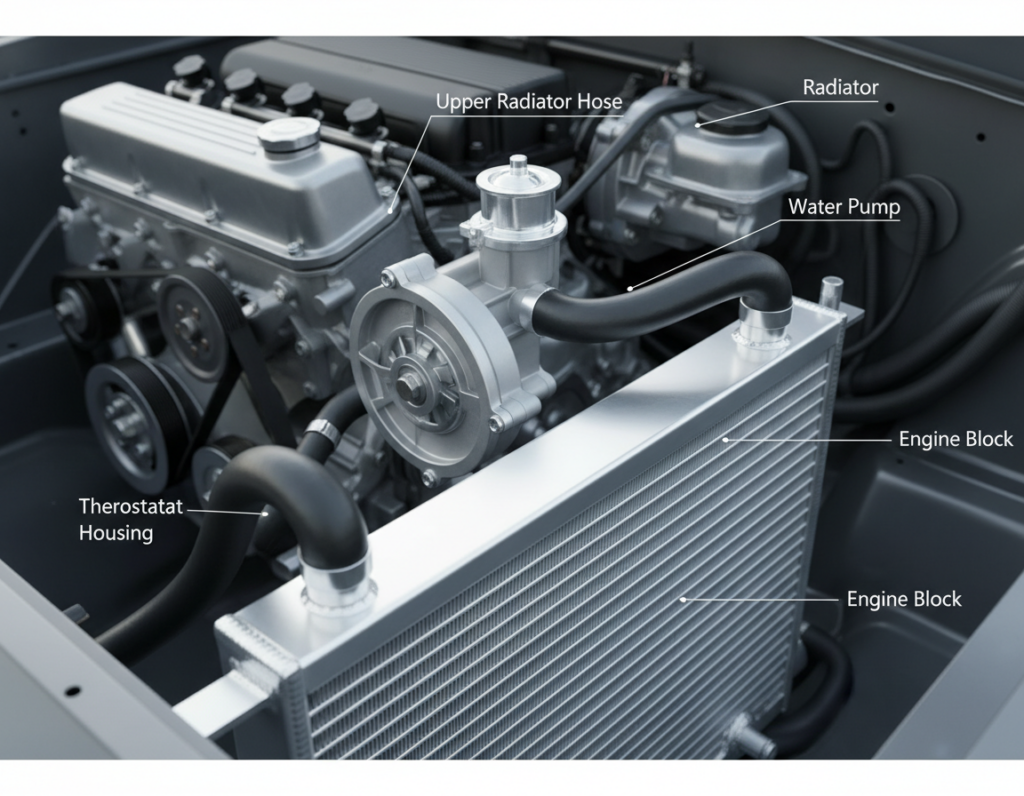
The radiator is an aluminum heat exchanger made of many small tubes and fins. Coolant moves through the tubes while air passes over the fins. That airflow through the grille and fans carries heat into the surrounding air.
Why it matters: a larger radiator or denser fin pack improves heat transfer, but poor airflow or debris can neutralize gains.
Water pump: circulation and hot-spot prevention
The water pump forces coolant through the block, head, and back to the radiator. Good pump flow prevents stagnant areas and local hot spots.
Poor pumping lowers overall transfer even if the radiator is oversized.
Thermostat: a temperature-controlled valve
The thermostat uses a wax pellet that expands as it warms. It usually begins to open around 180–195°F and is fully open near 200–218°F.
By routing flow appropriately, the valve helps the system reach operating temperature and hold it under load.
Radiator cap and overflow tank
The cap controls system pressure and sends expanding fluid to the reservoir. As the system cools, fluid returns from the tank to keep the loop full.
Check the overflow tank level regularly to spot leaks or a failing cap.
Heater core and hoses
The heater core is a small radiator used for cabin heat. Hoses route coolant between components and are common leak points as clamps and rubber age.
- Component map: radiator ↔ hoses ↔ engine block ↔ pump ↔ thermostat, with heater core as a branch.
- Troubleshooting tip: rising temp only at speed usually points to airflow (radiator or fins); high idle temp suggests pump, circulation, or pressure faults.
How the Cooling System Works Under Load in Real Driving
When the car is pushed hard, heat production rises quickly and the coolant must carry away far more energy.
Coolant flow path
The pump pushes coolant through passages in the block and head so the fluid absorbs heat from combustion and friction.
Hot coolant then moves to the radiator, where air through the grille cools it before it returns back to the engine.
Bypass vs. radiator flow
When cold, the thermostat keeps coolant circulating inside the engine via a bypass so the engine warms quickly.
Once the thermostat opens, the valve routes more flow through the radiator and the balance of heat in vs. heat out stabilizes temperature.
What changes under load: more combustion and friction create faster heat rise, so pump flow and radiator heat rejection must increase.
- At highway speed natural airflow over the radiator does most of the work.
- In traffic, fans and ducting supply the needed air to shed heat.
- Temperature climbs at idle suggest poor airflow or fan faults; climbs at speed point to circulation or pressure issues.
| Condition | Primary cause | Driver symptom |
|---|---|---|
| High load | Increased combustion heat | Fast temp rise, higher fan duty |
| Poor airflow | Clogged fins or failed fan | Overheat at idle, normal at speed |
| Restricted flow | Water pump or passage blockage | Overheat at speed, low flow |
Keep the loop full and moving: cooled fluid returns back to the engine repeatedly, so a good pump, a healthy thermostat, and clear airflow are essential for stable temperature control.
Pressure, Boiling Point, and Why the Radiator Cap Matters
Pressurizing the cooling loop lets the liquid carry more heat before it turns to vapor. That rise in boiling point is a key performance tool on high-load drives.
How pressure raises boiling point:
- Higher system pressure increases the coolant’s effective boiling point so it resists forming steam pockets under heavy heat.
- Steam reduces heat transfer dramatically, so keeping the liquid phase intact maintains stable temperature and prevents hot spots.
What the radiator cap actually does
The radiator cap holds the loop at its rated pressure and vents excess to the overflow tank. When the system cools, fluid returns to keep the loop full.
Signs and risks when pressure is uncontrolled
Look for repeated low coolant level, overheating during pulls, swollen hoses, or a sweet coolant smell. These often point to a weak cap, leaky parts, or poor seals.
Unchecked pressure can cause real failures: burst hoses, stressed gaskets, head sealing damage, or even block problems from sustained boiling and loss of heat transfer.
Practical steps: use the correct cap rating for your setup, inspect seals and hoses regularly, and pressure-test the loop when you see symptoms. Boiling is more than a nuisance—it signals failing heat transfer that can lead to major damage if ignored.
Design Priorities for Effective Cooling in High-Output Builds
Effective thermal design starts with targeting the hottest spots rather than simply adding bulk cooling capacity. That focus keeps critical materials and seals within safe limits when power and rpm rise.
Preventing hot spots
Tailor coolant passages around combustion chambers and exhaust ports so fluids remove heat where it concentrates. Proper passage sizing evens temperatures and protects head gaskets and mating faces.
Airflow and radiator strategy
Match radiator surface area and core depth to the vehicle’s duty cycle. Shrouding and ducting direct air through the core and stop leaks that reduce performance.
Cooling fans are vital at idle and in traffic. At speed, natural air does most of the work, but fans control heat soak and low-speed airflow shortfalls.
Coolant chemistry choices
Street builds usually run water/glycol blends for freeze protection and corrosion control. Choose the right inhibitor package (IAT, OAT, or HOAT) for long-term reliability in US climates.
Oil as a secondary path
Piston underspray and oil coolers remove localized hot spots from moving parts. Managing oil temperature keeps bearings and pistons durable under sustained load.
Balancing competing needs
Intake areas benefit from cooler air while the rest of the engine needs a stable operating range. Design choices should trade off local cooling with overall temperature control.
- Upgrade order: improve airflow and radiator efficiency → verify pump and thermostat → add oil cooling or refined coolant blends.
- For street cars in the US, keep antifreeze mix and corrosion inhibitors appropriate for winter protection.
How to Maintain and Check a Car Cooling System for Peak Performance
A few quick checks each month can stop small leaks from becoming costly repairs.
Quick visual inspection: look at hoses and clamps for soft spots, cracks, or crusty residue. Check the overflow tank level when the car is cold and note any wet spots under the vehicle.
Leak clues and what they mean
A sweet smell, white crust near hose ends, or damp radiator end tanks usually signal coolant loss. Moisture around the heater core or unexplained low reservoir level can precede overheating.
Thermostat and pump warning signs
Slow warm-up, temperature that wanders, or sudden overheating after normal driving suggest thermostat trouble. Overheat at speed, weak cabin heat at idle, odd noises, or seepage near the pump point to circulation or pump faults.
Coolant service basics and contamination checks
Keep the correct water-to-coolant mix for your car and climate. Do not mix incompatible coolant types; that reduces corrosion protection.
Inspect for oil in the coolant, rusty color, debris, or sludge—these indicate contamination or neglected service intervals.
Why this matters: stable fluid and pressure deliver steady temperature, which protects timing, head gaskets, and boost performance under load.
If loss, repeated overheating, or pressure issues persist, perform a pressure test and seek professional diagnosis before serious damage occurs.
Conclusion
Protecting performance means managing heat before it turns into a failure point.
Keep the takeaway simple: a sound cooling system warms a car engine quickly, then holds a steady operating range to stop hot spots and boiling. Proper balance matters more than lowest temperature.
Parts work as a team: the radiator sheds heat, the pump moves coolant, the thermostat controls flow for warm-up and stability, and the cap/overflow manages pressure and recovery.
Maintenance first: many overheating problems start with leaks, weak caps, worn hoses, or degraded coolant—not just an undersized radiator. Inspect the loop regularly.
Check coolant level and condition, fix symptoms early, and you’ll keep repeatable power, better reliability, and fewer temperature-related failures for the life of the build.