
Anúncios
Quiet and comfortable cabins mean consistent sound levels, clear tonal balance, and a calm interior for every passenger. This is a system-level discipline, not just adding insulation. Modern teams blend acoustics, structure, and controls to shape how a cabin feels.
Read on for a practical, step-by-step guide that mirrors how OEMs and engineering groups approach noise, vibration, and sound quality in today’s cars. You will see methods that prioritize full-car testing over isolated fixes.
Electrification changes the rules. With fewer masking engine sounds, high-frequency tones and road-born vibration become more noticeable. That shift raises expectations for perceived quality and safety in the U.S. market.
We will preview the main sources—powertrain, tires, road, and structure-borne paths—and explain why measuring sound across frequencies matters to avoid fixing the wrong problem. Key tradeoffs run through the article: control vs weight and performance, cost vs scale, and comfort vs driver awareness.
System thinking matters: changing one component can move sound elsewhere, so teams validate at the full-car level to protect interior quality.
Anúncios
The rest of the article: Section 2 explains cabin sources; Section 3 covers the workflow; Section 4 explores design and materials; Section 5 shows how to apply the approach.
What Makes a Car Cabin Noisy in Modern Vehicles
Modern cabin comfort comes from understanding which sources drive interior sound and how they interact across frequencies.
Air‑borne and structure‑borne pathways behave very differently. Air‑borne sound includes tire hiss, wind, and motor whine that travel through vents and gaps. Structure‑borne vibration arrives through suspension and body panels and couples directly into trim and glass.
Anúncios
Combustion engines create broad‑band energy that often masks road hum and small resonances. By contrast, an electric motor can create narrow tonal components and higher‑frequency content that become obvious once the engine masking fades.
Tire tread and road type matter. Coarse asphalt, concrete grooves, and aggressive treads raise cabin levels at highway speeds. Once the powertrain quiets, those inputs often become the dominant source felt by passengers.
Perceived quality depends on both measured decibels and tonal balance. Designers must also preserve driver and pedestrian awareness, so cabins are quieter without becoming isolated bubbles.
Practical takeaway: prioritize paths and frequencies, not single parts. The noisiest contributor is often the hardest lever to change, so teams map sources before specifying fixes.
Vehicle noise reduction engineering workflow for quieter cabins
Set concrete targets up front; measuring the cabin’s spectral signature turns opinion into data.
Start by defining what “good” looks like for different speeds and load cases. Take full-spectrum measurements to pinpoint dominant bands and tonal issues across frequencies.
Run NVH and finite element analysis early
Use finite element models and NVH simulation before hardware exists. This predicts vibration paths and avoids late-stage fixes.
Body-in-White analysis
Analyze the BIW for stiffness gaps, panel resonances, and key transmission points. Small connection changes often cut vibration transfer at the source.
Trimmed body modeling with ATF/VTF
Model the cabin with trim installed to compute Acoustic Transfer Functions and Vibration Transfer Functions. That reveals the most efficient paths into the interior.
Full-vehicle validation and iteration
Validate with acoustic simulations and sound pressure mapping. Run proposal–adjustment–verification cycles to balance cost, weight, and timing.
Practical tradeoff: when structural fixes meet targets, teams can avoid heavy insulation or active control and protect performance and efficiency.
Case outcome: one EV program reported a 30% cabin reduction validated by full-vehicle NVH testing with no added BIW mass and zero reliance on active cancellation.
Design and materials that reduce noise without sacrificing performance
Smart material decisions let teams tame road inputs while protecting performance and packaging.
Toolkit overview: use damping to cut panel resonance, insulation to block air‑borne sound, and decoupling to interrupt transmission paths.
Damping, insulation, and decoupling — when to use each
Damping products change panel behavior by converting vibrational energy into heat. They tame peaks and smooth tonal responses but can add mass if overused.
Insulation materials reduce air‑borne sound into the cabin. They work well for tire and wind energy but face packaging limits in modern light‑weight designs.
Decoupling uses bushings, isolators, or layered mounting to break mechanical paths. This often yields big gains for structure‑borne road input with minimal weight penalty.
Joining and mounting strategies
Simple changes in joins and fasteners alter how energy flows through the body and trim. Align mounting design with TB/ATF/VTF results to get the most impact early.
“Pick the right tool for the dominant path — treat the symptom, not just the panel.”
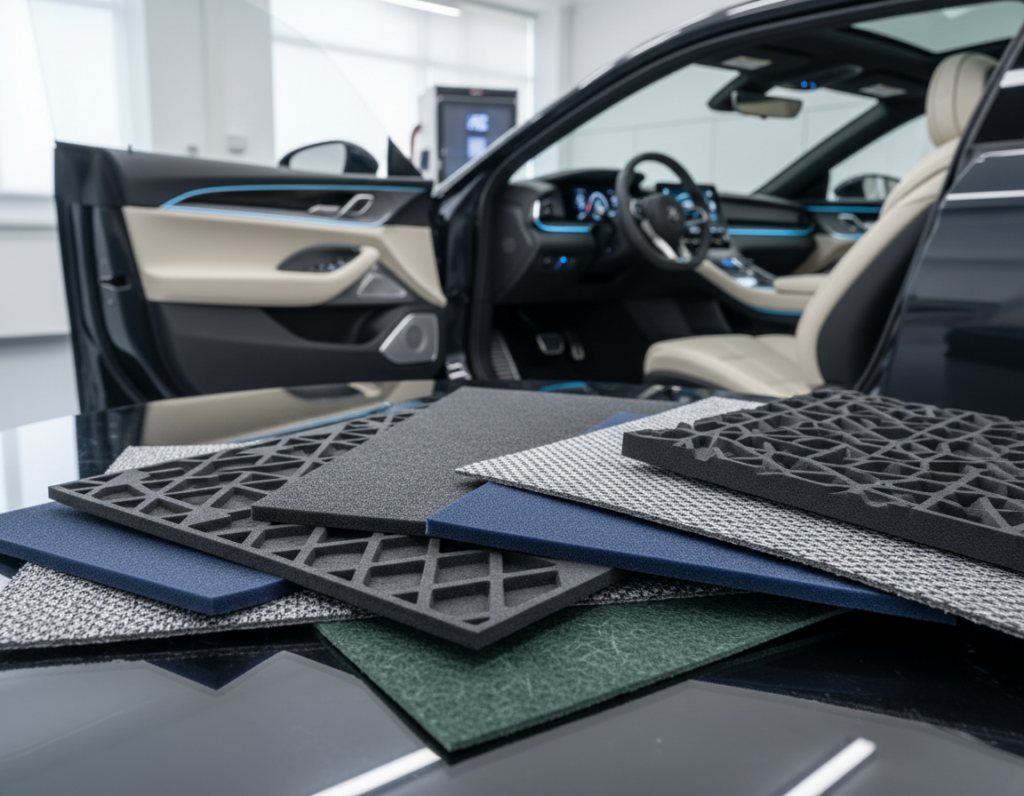
Common product categories include insulation materials, damping materials, speaker baffles, and accessories like Boom Mat/DEI. Use them as targeted fixes, not blanket solutions.
Decision mini‑framework: if structure‑borne issues dominate, prioritize damping, decoupling, and join fixes. If air‑borne sound wins, prioritize insulation and sealing, then validate in the car.
Conclusion
A systems approach—measure, model, fix, then validate—keeps interior goals on track.
Begin with clear targets and full-spectrum measurement. Use FE and NVH models early to predict paths, then prioritize fixes to structure and transfer paths before piling on mass or insulation.
Treat the car as connected: one change can move a problem elsewhere, so iterate with trimmed-body transfer maps and full-vehicle sound mapping.
EVs make higher-frequency vibration and road inputs more obvious, so focus on path control, targeted materials, and smart mounts to protect passenger comfort while preserving efficiency and safety.
Action checklist: identify the primary source (engine/motor vs road), map the path (air‑borne or structure‑borne), select design and materials levers, and confirm with in-cabin validation metrics. For background on engine noise categories and mitigation, see engine noise categories and mitigation.
Final thought: quieter, higher‑quality interiors come from a disciplined process, not guesswork—combine design, materials, and verification to deliver lasting results for every passenger.


 English